How to biblically earn more
P.S. I'm not a financial advisor or spiritual teacher. This is all from my own quiet times and digging...
For awhile now I've carried guilt about being ambitious. A lot of my career decisions felt like I was choosing work over God. As I've matured, I've come to see it differently: ambition can be Godly when it's pursued biblically. That's what I've been spending my afternoons researching on.
This whole research spree started with Sacred Men's How Christian Men Can Increase Their Earning Capacity: Vocation and Wealth (a lot are referring to the host's sayings)
"Is it okay to want more money?"
Sometimes as Christians we can have some sort of false guilt when it comes to wealth. Where we can sometimes treat material wealth as suspicious, as if a Godly person is someone who earns just enough, just to meet his needs and no more.
This simplicity or 'just enough' is then confused with righteousness, and then ambition or 'wanting more' is then labelled greed.
If we open up the bible, there are so many Godly men who were very wealthy; Abraham (Genesis 13:2) he owned a bunch of livestock, gold and silver → Joseph, by the grace of God and passing of tests, he became the second in command of the most powerful nation at that time, he used that position to save his people and family.
→ God never called that a problem.
Now we know the book of Proverbs is a book that directs and advices us on how to live in a biblical way; the way God wanted us to.
Now let's look what Proverbs have to say about wealth and money:
- Proverbs 10:4, "Lazy hands make for poverty, but diligent hands bring wealth."
- Proverbs 13:22 "A good person leaves an inheritance for their children's children…", meaning the optimal good person based on Proverbs must be very rich, to be able to leave inheritance to not just their children but to the generation after.
- Proverbs 21:5 "The plans of the diligent lead to profit as surely as haste leads to poverty."
The book of Proverbs expects the Godly to build wealth through diligence, planning, and discipline.
So what is the problem? 1 Timothy 6:10
"For the love of money is a root of all kinds of evil. Some people, eager for money, have wandered from the faith and pierced themselves with many griefs."
The verse does not say money is the root of all evil, but the "love of money" is the root of all kinds of evil. It's not the earning of money, the possession of money, or the desire to build security for your family,
but the problem is the disordered love of money where we put money above God, as our ultimate pursuit, my ultimate value and security. Money is the thing I love more than anything else and where I get my security and identity from. And we put money as our God.
So how do we pursue money biblically and righteously?
→ To see ourselves as stewards, Psalms 24:1 "The earth is the Lord's and everything in it."
- Everything is owned by God → including everything we earned, everything we own, everything we've accumulated, invested, ultimately it's God's.
- The reality is that we are just managing God's resources on God's behalf.
The question is not, "How much money is enough for me, but how much can I adequately and faithfully steward for God?"
When you understand that every paycheck, dividend, money you earn is God's and you are a steward, this will change your entire motivation on earning money.
- You will not be trying to make more money to earn recognition or impress others
- or to prove your worth and gain security from
because ultimately it's not yours and will not become your selfish ambition anymore.
Money is just the instrument, not the goal.
It is a tool God puts in a steward's hand to accomplish something.
The moment the tool becomes the goal, it stops being a tool and becomes an idol.
So the goal is not to be rich, but to contribute to God's glory through what we do with what He gave us.
And a steward with a 'good and many' instrument simply has more in his hands to glorify God with.
Suddenly earning money is not "How can I get more?" But "How can I give more?"
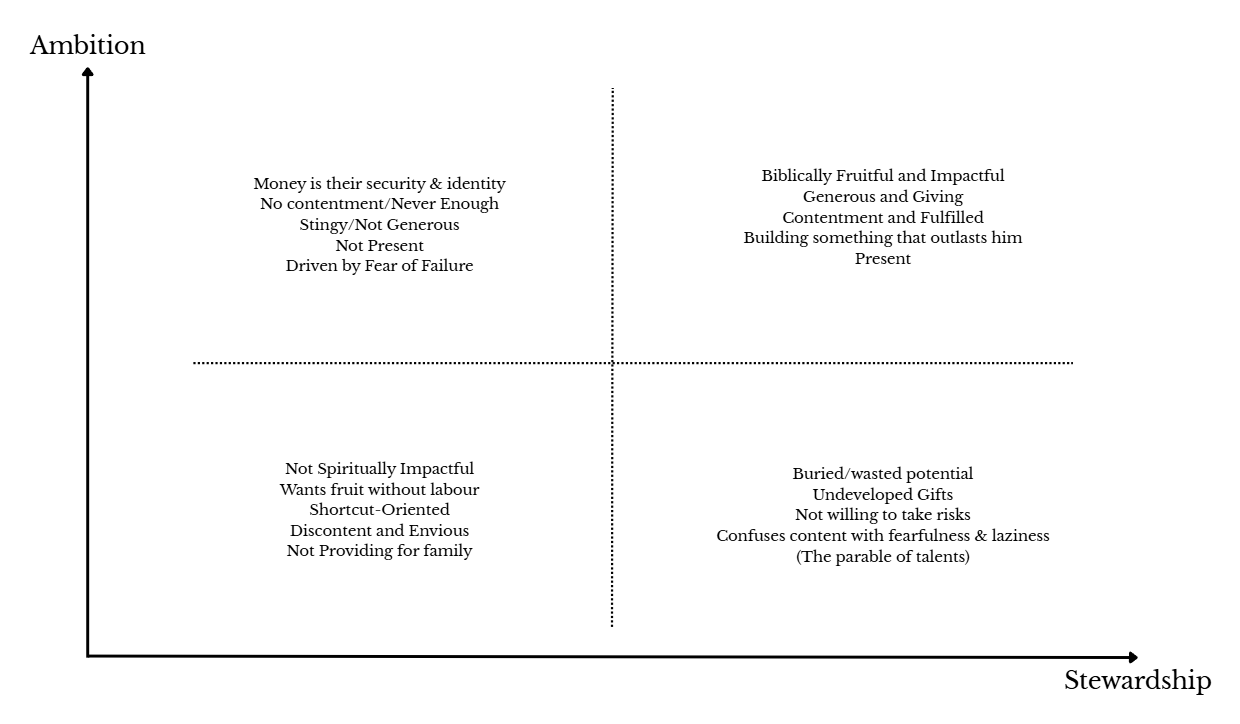
With all this in mind, you will be pursuing more capacity and resource in order to provide for the household, and to be able to give more generously to the church or to help others, and to build something that outlasts you that bears witness to the faithfulness of God.
More income to a good and faithful steward = more kingdom impact.
Now this is Godly ambition, not selfish ambition.
1 Timothy 5:8 "Anyone who does not provide for their relatives, and especially for their own household, has denied the faith and is worse than an unbeliever."
Okay this one is maybe focused on men but it's one of the strongest statements in the bible on obligation of a Christian man to be a provider for his household.
Paul is saying: failing to provide for your household → is a denial of your faith → worse than an unbeliever.
Paul here is talking about refusal, not inability. Imagine someone having an incident and needing CPR, and there is a doctor who is a bystander but wouldn't do it. He'd be doing worse than the other bystanders knowing he could be doing something.
A Christian proclaims a God who provides, so refusing to provide doesn't just neglect your household, it denies the God you say you trust can provide for your family, by not allowing God to use you. You contradict the God you claim to believe in.
And of course provision or providing is not just a paycheck, it involves your presence, time, protection, availability, stability and security you provide. A man who provides a high income but is never home does not provide for his household.
The problem with some Christians is that they've accepted a lower level of provision that is less than what God has made them capable of, and they've called it contentment.
Real contentment is not accepting less and being okay with it. Real contentment is being at peace with God whatever the circumstances, while doing everything in your power to work excellently and to provide well.
We can be ambitious and be content at the same time.
How to earn more money biblically
1. Be insanely good in what you do.
Proverbs 22:29 ESV, "Do you see a man skillful in his work? He will stand before kings; he will not stand before obscure men."
To master your craft, this is probably one of the best and reliable ways to increase your income is to genuinely be absolutely amazing in what you do.
Not good enough, not average, but excellent, skillful, good at a niche.
Someone who has such a niche skill, for example the best consultant in AI for example or any field, is for sure gonna get the most work and make more money. The best and number 1 AC installer in Jakarta is for sure gonna get work.
The person who is genuinely amazing, not just good, in your field or a specific niche, that person will not struggle to find work, rather work will find him.
Which means you need to assess yourself and see where you lack and what you can improve. Are you good at what you do? Or just average? Have you accepted that or are you okay with that?
Or are you continuously learning? Investing in yourself to improve your craft? Are you taking certifications or training to get better? Are you reading books or listening to podcasts that could help with your craft? Do you have mentors who can guide you to be better?
Here's a practical: with whatever field you are in right now, is there one specific niche in your broad skill that if you focused on it for 12 months would exponentially increase your earning capacity?
For example: for me, AI hacking is super new in cybersecurity, and in Indonesia the literacy is still really bad for this, before it gets better I want to take this one certification and training that would bolster my understanding and experience. And getting this certification would also up my reputation as an expert, which would definitely get me AI hacking work.
Identify one skill and develop a 12 month plan for the coming year. Don't forget the diligent man plans. (Proverbs 21:5 "The plans of the diligent lead surely to abundance.")
2. Integrity and reputation.
"Choose a good reputation over great riches; being held in high esteem is better than silver or gold." (Prov 22:1 NLT)
"A good name is better than precious ointment." (Ecc 7:1)
Your character and reputation is your most valuable asset. Now your mastery, or how good you are, is what invites you to the room. Reputation and integrity is what invites you back.
It's not about what you've done, what school you went to, how good your resume is, not your network, but your reputation for integrity, reliability, where your yes is yes and your no is no. Your reputation and integrity revolves around every area of your entire economic life.
Employers would pay a premium for someone who has a good reputation, someone who is loyal and does not switch companies every year, who tells the truth, who comes on time, handles tasks with initiative, and over delivers.
Or in business, where customers return to trustworthy businesses or refer others to your business — word of mouth is the single highest converting way of marketing. For example, in my businesses the conversion rate is around 2% for organic marketing/UGC, and about 5% for paid ads. While word of mouth is at 30-50%, depending on the relationship. Not only is keeping a good reputation the most converting way of marketing, but it's also the cheapest and most inexpensive way of marketing.
I have a friend who works in tech consulting, and he has a company of around 20 tech consultants/engineers, and all of them are technical people — they have 0 sales nor marketing, they barely have an online presence, but they continuously land clients because their reputation is so good and they always overdeliver.
"Slaves must always obey their masters and do their best to please them. They must not talk back or steal, but must show themselves to be entirely trustworthy and good. Then they will make the teaching about God our Savior attractive in every way." Titus 2:9-10
Our integrity and reputation at work and how we do business should also be a big part of our Christian life. Why? Because for the watching world — co-workers, friends, business partners — they also evaluate our God through how we work or do business.
Are you someone who pays vendors on time, or someone who pays when chased?
Someone who honors a quote that turned out to be underpriced, or someone who finds a way to renegotiate?
Someone who over-promises their clients/boss that it'll take 2 weeks to finish a project but under delivers?
Someone who barely works during WFH or remote days?
All of this is going to destroy your reputation.
Instead you want to be someone who underpromises but overdelivers. "Yeah I'll get it done in about 10 business days" but finish it in 5. "Yeah we'll try our best to fit that standard", but surpass it even more and over deliver. Do this consistently and with discipline to the point where others know that's just who you are and a part of your character. Be the underpromising man who overdelivers at all times.
3. Being generous.
The most generous people I know are also the most financially free people I know.
I'm sure everyone has heard this verse: Matthew 6:21, "For where your treasure is, there your heart will be also."
The world teaches us to read it backwards, that our treasure follows our heart. For example, you love something so much you would spend on it.
Jesus says the reverse. Your heart follows your treasure.
So whenever you give sacrificially we are teaching our heart where to go. Giving is not just a financial action. It's a form of spiritual practice.
It rearranges your priorities.
It resets your loves.
It reminds you who truly provides.
Often when I give or when I am calculating what my 10% is (for tithing), the first thing that pops up in my head is everything I could buy with it, the fear that I won't have enough, the fear of not being secure, the fear that someone is getting ahead of me, the fear of missing out.
But the moment you press "complete transaction", you're making a statement: "My security is in Christ, not in monetary security" — and all those thoughts and fears go away.
It's not "How can I get more?"
But "How can I give more?"
Giving breaks the love of money by opening your hands, your heart to God's purposes.
Giving and tithing now become a tool to bring you back to Him.
Proverbs 3:9 "Honor the Lord with your wealth, with the firstfruits of all your crops; then your barns will be filled to overflowing, and your vats will brim over with new wine."
So how do we actually earn more by giving and being generous?
The answer is not: give money, receive money.
The answer is: generosity makes you a man God can safely trust with more.
You become a steward who can be entrusted with more talents, and whether God grants it is entirely His call.
Matthew 25:21. "Well done, good and faithful servant. You have been faithful with a few things; I will put you in charge of many things."
God does not hand more capital to someone who consumes it. God hands more to the one who multiplies it.
If you can't even be generous and give now, how can God trust you with more?
By giving generously, you hand God the decision.
You are not making the increase happen. You are removing yourself from the throne and letting the Owner decide what to entrust you with next.
The test: if God never returns a single rupiah, was the giving still worth it?
If yes, you're a steward. If no, you were investing and calling it worship.
Habakkuk 3:17-18 "Though the fig tree does not bud and there are no grapes on the vines, though the olive crop fails and the fields produce no food, though there are no sheep in the pen and no cattle in the stalls, yet I will rejoice in the Lord, I will be joyful in God my Savior."
4. Take more risks.
Remember the servant who buried his one talent. By cultural standard, he's actually the safe one.
Scripture calls him wicked.
If we dig deeper, the real reason why he didn't risk it could be found through his response: Matthew 25:24 "Then the man who had received one bag of gold came. 'Master,' he said, 'I knew that you are a hard man, harvesting where you have not sown and gathering where you have not scattered seed.'"
What was the problem? He did not lose any money. He returned what he was given.
→ It was his view of his master.
He saw his master as someone who was harsh, failure meaning punishment, someone waiting for him to fail, so he decided to protect himself instead.
His fear was dressed as caution. The two other servants had the same risk, maybe even more since they had more to lose, but they had a completely different view of who their master was.
2 Timothy 1:7 ESV, "For God gave us a spirit not of fear but of power and love and self-control."
The main point: how we take risks is a direct reflection of how we view God.
If you view God as a hard, punishing master waiting for you to fall, you'll bury your talent. If you see God as a good, loving Father, you'll risk everything He gave you.
Now let's get practical:
Once again, not financial advice, I'm just a kid trying to risk more for God.
But from what I've seen in my life is that almost nothing that increased anyone's income here happened without risk.
Leaving a stable job. Starting a business. Quoting a project bigger than any you've done. Hiring your first employee. Investing in a certification with money you'd rather keep. Putting your name on something publicly where it can fail in front of people. Making content. Asking for a raise.
But this all ties back to point 3 also — if your god is money, you wouldn't risk it. Risking your 'god' is unthinkable to the risker. But if we see money as a tool/instrument that God has given us, suddenly we can move.
- Practical 1: Start writing down what your talent is. In the parable, talent is a form of money, but what God has entrusted you with is more than just your bank account — what skills you have, work experience, platform, network, reputation, time, capital, relationships. Make 4 columns: Skills (Good at __), Time (10PM - 12PM, every Friday night 6PM-12PM, etc), Network (Close with ___ who is a ____, best friends with ____ who works at ____), Assets (a good laptop, a roof to live under, ___ rupiah in the bank, etc). Under each write everything you've been given. Write them all down, in the process I'm sure some ideas will pop up :) (I've done this multiple times).
- Practical 2: Have a great council. When about to attempt a risk like quitting your job, asking for a raise, opening a business, hiring someone, investing in a business, bring it to three councils. Not three people who would agree — one who understands and is experienced in that specific domain, one who understands your finances and can be another health check if the downside is manageable, one who knows you spiritually and can tell if you're moving based on faith, not ego or greed (maybe your discipler, or a full-timer you're close to).
- Practical 3: Define what failure looks like before you start. "If I have not reached ____ before ____, I'll stop", "I will not put more than $____, regardless of what happens", count your cost before you build. When failure happens, run a post-mortem, do it right after failing, early enough to remember what went wrong. "What did I assume that went completely wrong?", "What decisions have I cumulatively made that resulted in this, and how can I do it differently next time?", "What did this cost me, and what did it teach me?" Run all of this through the three people in your council, get their feedback. Do not hide or bury your failure, take it as a lesson and see it as an attempt. Proverbs 24:16, "For though the righteous fall seven times, they rise again."
Now of course there is a guardrail for risk. Don't just go crazy and throw your life away.
Even Jesus commends thorough planning and counting the cost, Luke 14:28, "Suppose one of you wants to build a tower. Won't you first sit down and estimate the cost to see if you have enough money to complete it?"
Risk without calculation isn't faith, it's testing God.
Faith-risk: you counted it, you can survive the downside, you prayed, you moved.
Reckless-risk: you didn't count it, the downside ruins your household, and you're calling it trusting God.
Remember 1 Timothy 5:8. Wisdom, prayer, counsel is what helps the planning and your risks to work out.
The question is not "can I afford to take this risk" but "Can I stand before God knowing I buried what He has given me?"
Questions to ask myself:
- What is the one thing you know you should be doing, that you're not doing, because you're afraid it might fail?
- What have you buried? A skill, a business idea, a calling, a platform, an opportunity you've been sitting on for years?
- When you imagine bringing that risk to God, do you see a hard master waiting for you to fail, or a Father who gave you the talent in the first place?